
Textiles for year 9-13 students (13-18) at Fairfield College in Hamilton, New Zealand. This blog provided information for the students and their whaanau, and showcased their learning from 2017-2019.
Sunday, 18 June 2023

Monday, 8 November 2021
Monday, 19 April 2021
Sewing for Beginners
Sew Easy Fabrics for Beginners

Congratulations!
You have already sewn some small projects and are set to move on to sewing your
own garment. Perhaps you are now getting ready to sew your first dress
and looking forward to wearing your first creative sewing expression. And if
you are a bit nervous that it will not turn out perfect, don’t fret. We all
make mistakes but working with certain fabrics for beginners could make your
first sewing project a sure success!
Fabrics for beginners
As you start to go
beyond the invisible border of buying clothes and getting ready enter the
wonderful world of sewing, it is important to know that there are fabrics that
are more adaptable than others. Generally, one of the most manageable fabrics
to work on is cotton. This versatile fabric can be as light as a handkerchief
or heavy like a canvas and is the fabric of choice for shirts, skirts,
trousers, jeans, and dresses.
Fabrics can either
be woven or knitted. It can be also be made from animal fibres, plant fibres or
man-made fibres. Since knitted fabrics stretch more than woven fabrics, this
makes them harder to manage –so let’s start sewing with woven
fabrics first, like moleskin and smooth corduroy, which are almost always
made from cotton. These fabrics are also relatively cheap. Stay away from
cotton jersey though, because it is a fabric that is knitted by machine from
fine cotton threads, making it quite stretchy and not as easy to work with.
Heavy-weight cotton fabrics like denim may also be a bit difficult to
manipulate. Have a look at our article on Tips for Sewing Denim if
you want to have a go.
Tips for Sewing Denim: Easier Than
You Think!
Try woven linen first
Woven linen is also ideal for your first garment project.
It’s available in a variety of weights and is great for summer wear. Take note
that linen, which is often blended with cotton, tends to crease a lot and can
be a bit expensive. Therefore, the best project for beginners using linen
are tunics, sleeveless blouses and loose shirt dresses, pyjama pants.

For a fun and easy
project please take a look at our super easy tunic, the perfect
project to build your sewing confidence.


If you want to sew
a skirt, you can also opt for woven wool for that posh look, but this fabric is
expensive. Synthetic or man-made woven fabrics like polyester and polycotton
are recommended as fabrics for beginners. Crease resistant and
lightweight, they are cheap and manageable. Finally, cotton velvet is stable
and is great for skirts and simple but glamorous jackets.
Move on to knits as your skills grow
Generally, woven
fabrics like cotton, linen, and cotton-linen blend are great choices as fabrics
for beginners because they do not slip or stretch that much. Stay away from
knitted fabrics like shiny polyester, silk, rayon, and cotton jersey for now.
If you really want to have a go with knits, please check out our
article Sewing with Stretchy
Knits for some guidance.
Try to use light-
to medium-weight fabrics too and remember that heavy fabrics with bumpy ridges
are hard to manipulate. And make sure to choose fabrics with plain colours or
small prints since stripes, checks and fabrics with large patterns are tricky
in laying them out. Before you venture into knits, try your hand at
slippery fabrics that are easier to manipulate, at the top of your list should
be challis.
Choose the pattern, then the fabric
It’s also best to
buy your sewing pattern first. Choose your fabric later because patterns will
help you know not only what kind of fabric you’ll need, but also how much
fabric you should buy too. After choosing your fabric, you can then buy notions
like buttons, thread, and zips to match. We have a comprehensive list
of The BEST Online Fabric
Shops if you're looking for fabric.
If you did all
these steps, you are now ready to make your first garment. And before you know
it, you will be wearing your first creation. Have fun sewing!
Monday, 6 April 2020
Headbands
I've always wanted to make a bunch of headbands for myself and as gifts. Here are a few tutorials and links to patterns for three different headbands. These were sourced from online searches.
This is a great pattern for a knotted headband - for a baby 12 months or older. I'm going to adapt the pattern to fit a tween and an adult.
This is a similar type of headband with the knot on the top however, the fabric wraps around your head a couple of times and floral wire is used to to maintain any shape you desire.
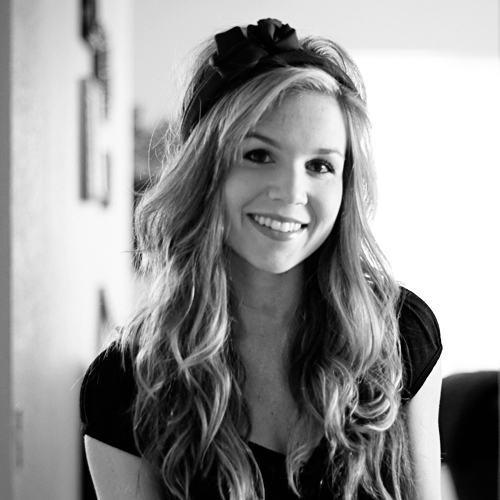
The great thing about these is
that there’s WIRE in
them so you can create whatever shapes you want and it stays put! You have the
freedom here to get creative, maybe even weave it through a side braid?! Plus,
you can choose all sorts of different fabrics and do a variety of thicknesses
and lengths! I’ve already made 3 :).
Here’s how you do it:
Step 1: Gather materials needed – Floral wire, Fabric, and basic sewing tools.
Step 1: Gather materials needed – Floral wire, Fabric, and basic sewing tools.
Step 2: Cut a strip of fabric wide enough to fold in half
(can be as thick as you want!) but make sure it’s long enough to go around your
head once or twice with some extra on the ends. I liked making mine super long.
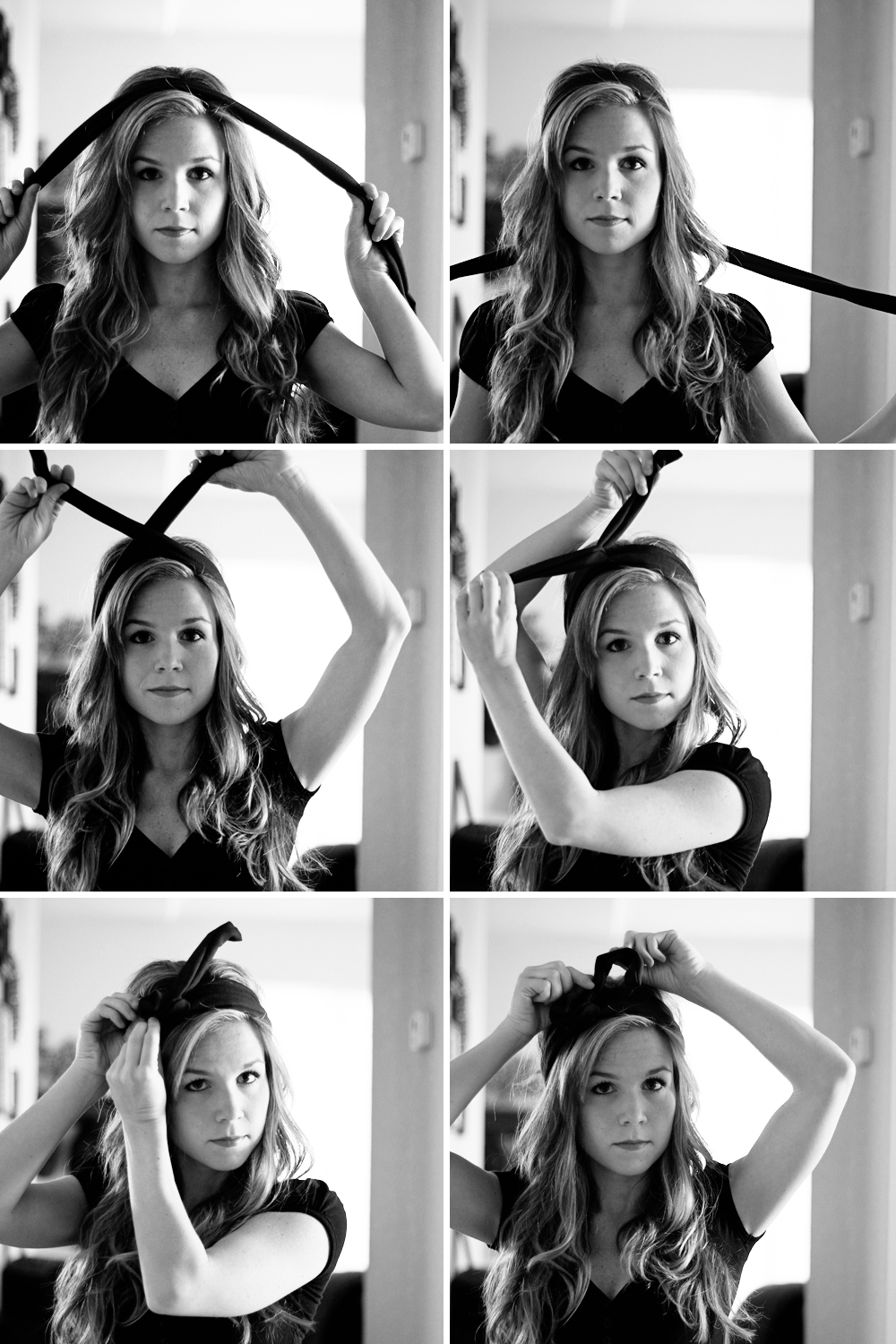
Step 7: Feed the wire through the fabric tube.
Here’s
me putting my hair wrap on:
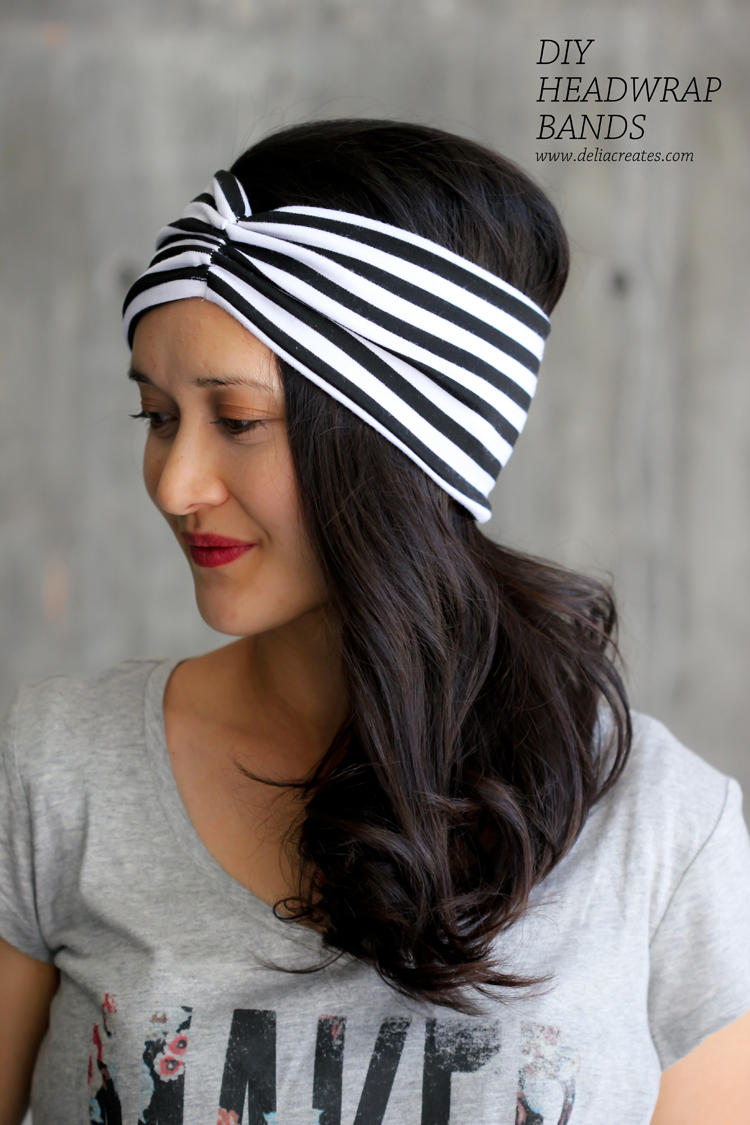
This last headband is a bulkier one, made with knit - stretchy fabric. It's important to use a jersey or ballpoint needle when using this fabric.
Materials:
Knit Fabric*
Jersey or Ball
Point needle (for sewing with knits)
Hand sewing
needle
Matching thread
Basic sewing
supplies (sewing machine, scissors, pins, etc.)
*You can use almost any kind of knit fabric. Light
weight knit usually has more stretch to it and its edges tend to curl, so it’s
a little trickier to sew, but will provide a more flexible fit.
First, measure your head.
LENGTH
Measure around your head from forehead down to the upper part of your neck and then back around.
LENGTH
Measure around your head from forehead down to the upper part of your neck and then back around.
For a mid-weight knit that is a little stretchy but
bounces back easily (has good recovery), use your exact measurements. It will
end up being a little bit smaller because of the seam allowances, but it will
stretch to fit your head nicely. If your knit fabric is really stretchy,
consider subtracting an inch from your head measurement. The fabric needs to
stretch some to fit your head without falling off.
If you are making the headbands to sell or as a
gift, here are general length measurements for a
mid-weight knit with good recovery:
Toddler = 19″
Girls =20-21″
Women’s = 22″
Girls =20-21″
Women’s = 22″
WIDTH
When cutting the width, decide how wide you want it, then double it and add 3/4″ for seam allowance (3/8″ x 2).
You can cut the width of your headwrap band to your preference. If you would like the thick headwrap look, the following is a good guideline:
Toddler = 6 3/4″
Girls = 7 3/4″
Women’s = 8 3/4″
When cutting the width, decide how wide you want it, then double it and add 3/4″ for seam allowance (3/8″ x 2).
You can cut the width of your headwrap band to your preference. If you would like the thick headwrap look, the following is a good guideline:
Toddler = 6 3/4″
Girls = 7 3/4″
Women’s = 8 3/4″
Now, let’s sew!
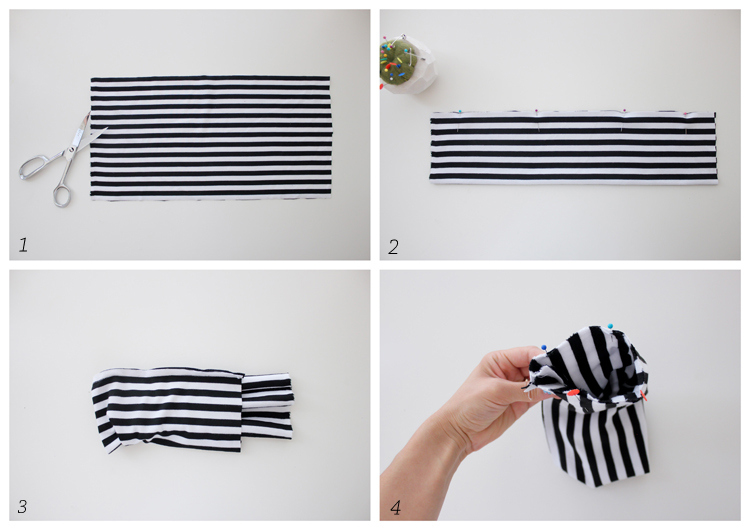
1. Cut fabric (see above)…
2. Fold it lengthwise and pin the long edges
together with right sides facing. Sew along long edges with a stretch stitch. I
used a narrow-modified zig zag stitch. A serger overlock stitch works great as
well.
3. Pull out the tube of fabric, you have just sewn,
halfway so that the two short ends meet with right sides still facing.
4. Make sure the seams line up (so the band won’t
be twisted) and pin the short ends together. Sew around leaving a 2-inch
opening unsewn. Make sure to back stitch when you start and stop sewing, so
that the opening won’t rip open any further when you turn the headband right
side out.
 \
\
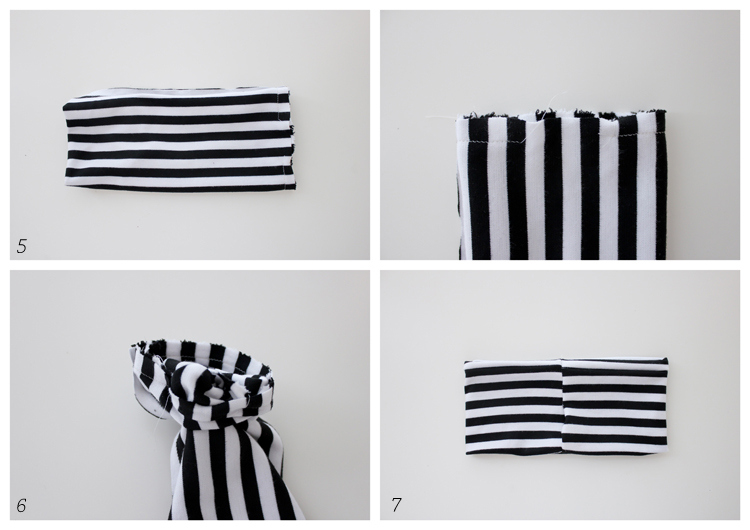
5. This is what your fabric should look like now.
6. Through the opening, pull your headwrap band
right side out.
7. Now you’re ready to do some hand sewing. If your
pattern/stripes don’t match up quite right, don’t sweat it! You are going to
ruche right on the seam and won’t notice it at all when you’re done.
Before we get to that though, we need to thread a
hand sewing needle and knot it off.
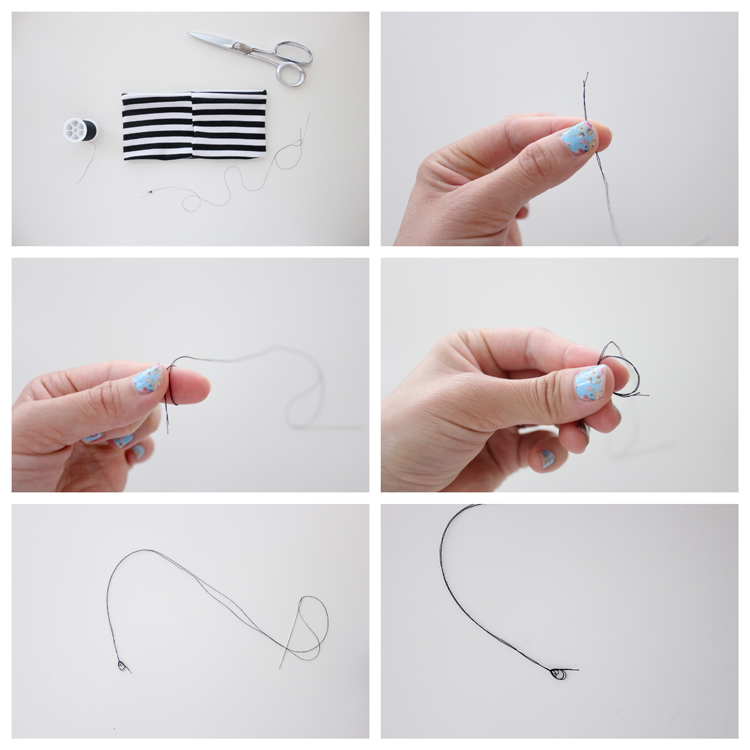
Double up your thread, wrap it around your finger,
roll the loop between fingers and pull needle end tight. Ta da! A knot.
It’s a messy, chunky knot, but that’s what you want.
Okay, let’s get back to sewing.
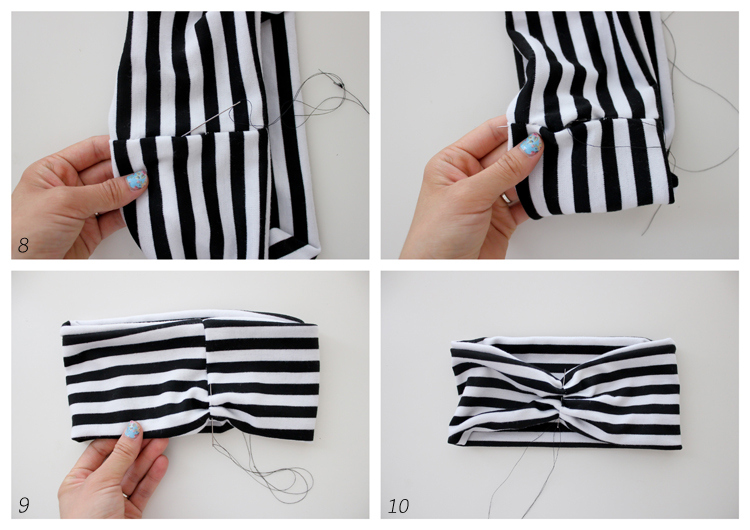
8. Insert your needle into the opening at the seam
and push the needle out the side (or really bottom) of the headwrap. The knot
should now be encased inside the headwrap.
9. With the needle at the bottom of the headwrap,
push it up through the seam of the head wrap, weaving it in and out of all
layers of the head band as you go. You also want to close up the opening
as you go. To accomplish this, weave back and forth between both sides, just
slightly as you weave upward.
10. When you get to the top of the headwrap, turn
around and weave it back down the seam in the opposite direction. Repeat this
about three or four more times, until the headwrap is securely ruched or
gathered. Knot it off in a discreet spot and clip your ends.
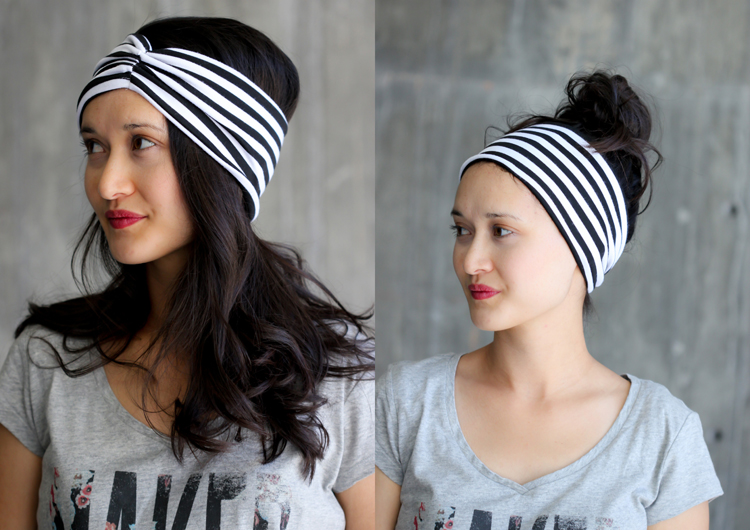
Headwrap band done and ready to wear!
You can wear the ruching in the front or flip it to the back, so the front has a smooth look.
You can wear the ruching in the front or flip it to the back, so the front has a smooth look.
Friday, 27 March 2020
Making Face Masks
This is all sourced from the following website: https://tianascloset.com/index.php/2020/02/06/face-mask-against-the-coronavirus-epidemic/
There are fairly simple instructions and pictures to guide you - I will be ensuring there are three layers rather than two and have used Winceyette which is a lightweight napped flannel typically used for pyjamas.
Here's a PDF of the pattern - print on A4 paper
Cut out 4-6 pieces fabric using your chosen pattern size(100% Cotton is best as it is 'breathable').
After cutting, you will have two-three pairs of fabric.
Stitch along the longest curved side 0.5cm from the edge.
Clip the curved edge to allow the seam to sit flat.
Place two of the completed pieces right side to right side, the third can be placed either way - I have chosen to place the pieces so that the print is what will be seen when wearing the mask and the white is the 'backing'.
Stitch along the long edges, leaving the short edges open.
Top stitch along the long edges 3-5mm away from the edge.
There are a range of different ways to prepare the short edges to attach or insert the elastic. In the interest of keeping it simple, I'll explain two simple techniques.
One (this is the technique I will use).
Neaten the short edges with an overlocker or a zigzag stitch.
Fold the short edge over 1.5cm and top stitch to secure - this creates a casing for the elastic.
Use a safety pin to insert each piece of elastic through the 'casing' that has been created. Overlap the ends of the elastic and zigzag stitch to secure.
Fold the short edges over twice, to hide the raw edge - at least 1cm per fold.
Top stitch close to the inside fold - this should create a loop that allows you to easily thread a piece of elastic through whilst hiding the knot inside the fabric.
**Alternatively, cut the elastic to the desired length, overlap the two ends to form a loop, zigzag stitch closed, and insert before stitching the 'casing' closed.
Thursday, 23 January 2020
Making a Bandana Bib
This is a great project for beginners and a fabulous way to up-cycle - by using old linen, such as towels and sheets. I’ve made a number of these over
the holidays and given these to friends as gifts.
I created a small and a large pattern on news print following the measurements below.

Here are some that I have made using a range of scrap fabric and old towels, following the video at the bottom.

I created a small and a large pattern on news print following the measurements below.
Here are some that I have made using a range of scrap fabric and old towels, following the video at the bottom.

Tuesday, 12 November 2019
Soft Toy/Neck Pillow Term 4
The Year 9’s are
steadily working towards completing their Upcycled Soft Toy/Neck Pillow. They have been reading and trying their best to interpret pattern instructions - which can sometimes seem like they are written in a variety of languages!
Here's an image of two that are almost completed. Keep up the good work Year 9s!!

Here's an image of two that are almost completed. Keep up the good work Year 9s!!

Saturday, 9 November 2019

Tuesday, 15 October 2019
Making a Scrunchie
So many of you have
been asking how to make scrunchies! Here is an incredibly simple tutorial to help you out.
Sunday, 13 October 2019

Wednesday, 21 August 2019
Level 3 - Pleats
There are many types of pleats, so which one do you want on your garment?
Visit this website for more information.


Level 1 Pattern Adaptation - Garment Construction Techniques
Year 11’s are currently working on pattern adaptations to create a skirt with a bib and straps.
There are a lot of techniques involved in the construction of their garments - watch the videos below and see how these ladies put their garments together.
What techniques do they use?
Wednesday, 7 August 2019
Senior Textiles
Senior
Textiles’ students have been working hard this year to construct garments that they are really proud of.
Year 11's have made Pyjama Shorts with a ruffle on the hem - this is an incredibly hard technique which requires a lot of patience and perseverance to complete to a high standard.


Year 12's have been working on construction a shirt with either a one or two piece collar, set in sleeves, and a button placket. These techniques require some practise as accuracy is the key.

Thursday, 11 July 2019
Completed Year 9 and 10 Projects
Term Two flew by really quickly! Year 10's began learning how to construct a Hooded Sweatshirt following tricky pattern instructions and some of the Year 9' began an Up-cycled Soft Toy.
Here's a glimpse at some of their completed work...


Friday, 21 June 2019
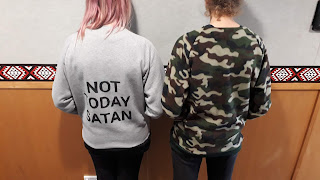
Hooded Sweatshirts, Term Two
Year 10’s are underway with the construction of their Hooded Sweatshirts!! They are doing a fabulous job supporting one another. Can't wait to show you their finished work.



Thursday, 30 May 2019
Friday, 29 March 2019
Year 10 Cushions
Year 10’s have begun applying designs to their cushion fabric using the silk screens to screen print and finding fabric to stitch on applique designs. Here are two examples below....
Tuesday, 12 March 2019
Screen Printing with Paper Stencils
Screen printing with paper stencils
This video is an example of how to screen print using paper stencils and multiple layers.
Watch the video below and answer the following questions:
- Name 4 things you will need
- What is the cello-tape used for?
- What areas do you cut out first?
- What do you need to think about when attaching your stencil to the screen (frame)?
- Why were a few layers of tape used to attach the stencil?
- How should you prepare your fabric?
- What is used to add paint to the screen?
- How many passes of the squeegee should you do, what type of pressure should you apply, and how should you hold it?
- How do you lift the frame off?
Wednesday, 14 November 2018
Year 9 Neck Pillow
Check out the progress the Year 9's are making on their neck Pillows. The heads were quite challenging to construct. I'm super impressed with the work this group is achieving each week.

Subscribe to:
Posts (Atom)