What Language Features and Techniques does Joseph use to deliver his speech and capture the audience's attention?

Textiles for year 9-13 students (13-18) at Fairfield College in Hamilton, New Zealand. This blog provided information for the students and their whaanau, and showcased their learning from 2017-2019.
Sunday, 28 May 2017

Thursday, 25 May 2017
Level Two Assignment Two - Checklist
|
INFLUENTIAL MOVEMENT/ERA 91340 CHECKLIST
|
|
RESEARCH
|
|
·
Complete a report about your chosen
movement/era– minimum 2 paragraphs
·
Discuss how cultural, historical,
societal, technological contexts influenced that era, and who the influential
designers of that were.
·
Complete a mood board that shows styles
and colours from that era/movement
·
Use 6 examples of your chosen garment from
your mood board to analyse,
·
Analyse each piece against the elements
and principles of design.
|
|
GENERATE IDEAS
|
|
Produce a minimum of 6 design concepts and label with the
following:
·
How has that movement/era informed your
design?
·
What are the aesthetic features of your
design?
·
How does your design function? E.g. where
is there a zip/buttons/hook and eye? Is it fit for purpose in relation to the
brief?
|
|
DEVELOPMENT OF IDEAS
|
|
Choose your favourite concept/s and develop it further by
changing:
·
Colour
·
Neckline, hemline, waistline
·
Add/take away sleeves, collar, pockets
etc.
·
Add embellishments – embroidery, lace
detail etc.
Add notes to each development that clearly states how the
design has been developed.
Identify your final design.
|
|
DEVELOPED FINAL DESIGN
|
|
Complete a fully rendered sketch of your final design –
front and back view.
Complete a technical drawing (flat/working/2D) in black and
white.
Evaluate your design – how have you integrated the
characteristics of the movement/era and met the brief.
|
|
TO DO BEFORE COMPLETION
|
|
Make sure that each page has a clear title and is completed
on an A3 piece of paper with a landscape layout.
|
Level One Assignment Two - Checklist
|
INFLUENTIAL DESIGNER 91067 CHECKLIST
|
|
RESEARCH
|
|
·
Complete
a report about your chosen designer – minimum 2 paragraphs
·
Discuss how cultural, historical,
societal, technological contexts influenced your designer.
·
Find 9 examples of your chosen designers
work,
·
Analyse each piece against the elements
and principles of design.
|
|
GENERATE
IDEAS
|
|
Produce a minimum of 9 design concepts and label with the
following:
·
Which of your chosen designer’s work
informed your design?
·
What are the aesthetic features of your
design?
·
How does your design function? E.g. where
is there a zip/buttons/hook and eye? Is it fit for purpose in relation to the
brief?
|
|
DEVELOPMENT
OF IDEAS
|
|
Choose your favourite concept/s and develop it further by
changing:
·
Colour
·
Neckline, hemline, waistline
·
Add/take away sleeves
·
Add embellishments – embroidery, lace
detail etc.
Add notes to each development that clearly states how the
design has been developed.
Identify your final design.
|
|
DEVELOPED
FINAL DESIGN
|
|
Complete a fully rendered sketch of your final design –
front and back view.
Complete a technical drawing (flat/working), 2D in black and
white.
Evaluate your final design – how has your design been
informed by your chosen designer and how does it meet the brief?
|
|
TO
DO BEFORE COMPLETION
|
|
Make sure that each page has a clear title and is completed
on an A3 piece of paper with a landscape layout.
|
Friday, 19 May 2017
Analysing Design - Aesthetic and Functional Elements


Take five minutes to analyse the above Karl Largerfeld garments (Year 11 the dress; Year 12 the coat), using sentence starters such as: I see, I notice, I can tell...
Aesthetic Elements: Relating to the appearance
Functional Elements: Relating to the use
Refer to the last page of your handout!!!
Thursday, 18 May 2017
Types of Fabric and Drawing Folds
Grab some scrap paper and practice drawing these 6 different types of folds


Sourced from Pinterest and Drawsh.com .Both of these sites are fantastic resources for exploring ideas about drawing the human figure, lines, and light.
Tuesday, 16 May 2017
Drawstring Bag Evaluation
Write your answers as paragraphs, using the
questions/statements as your sentence starters.
-
Describe the purpose of your drawstring bag…
The purpose of my drawstring bag is…
(refer to the brief)
-
Describe the fabric/s you chose…
I chose _______ fabric to use for my drawstring bag/pocket/applique
I chose _______ fabric to use for my drawstring bag/pocket/applique
-
Explain what you like and don’t like about your drawstring bag…
I really like/don’t like the colour/look/size…
I really like/don’t like the colour/look/size…
-
What went well when making your bag?
Pocket/applique/stencil/screen print/stitching together/inserting the drawstring
Pocket/applique/stencil/screen print/stitching together/inserting the drawstring
-
What didn’t go so well?
-
Is your drawstring bag fit for purpose?
Does the drawstring bag do what it is supposed to do? (relate to the brief!).
Does the drawstring bag do what it is supposed to do? (relate to the brief!).
-
How straight and neat is your stitching?
My stitching is…
My stitching is…
-
If you could remake your drawstring bag, what would you do
differently?
I would change… because
I wouldn’t change… because
I would change… because
I wouldn’t change… because
Sunday, 14 May 2017
Historical/Cultural/Societal/Technological Contexts in Fashion
These headings are convenient but they are not the end of the story. The boundaries between these areas are fluid and changes in one area are often tied to changes in another. For example a political event such as World War I had repercussions in almost every part of life: fewer resources (economic); women working in factories (social and economic); new weapons etc. developed (technological changes - which sometimes had an impact on fashion production); new attitudes (social) etc.
- Political
events
- major events such as wars
- legislation which had an impact on social
conditions (e.g. Women's suffrage)
- Economic
conditions
- major events, e.g. The Depression
- the amount of disposable income available to
spend on fashion items
- trade restrictions
- conditions of workers
- Technological
changes and advances
- the development of fabrics
- improvements in apparel production techniques
- new inventions, e.g. the zipper
- Social
conditions and changes
- attitudes to morality
- development of youth culture/'generation gap'
- growth of any subcultures.
- the status of women
- attitudes to the body (concealment vs
exposure)
- Art/Design/Music
developments
- any contemporary cultural trends that influenced fashion design, both main stream and counter culture.
Information from boxhill.edu.au
Monday, 8 May 2017
Fashion Illustrations

In this assessment you are required to sketch your concepts and develop your ideas on the human form
A fashion illustration is created with the use of a Croquis. A Croquis is a french term used to describe a sketch of a model's silhouette. You can use the templates in class or explore a range of styles here and here.
Once you've chosen a croquis style that suits you you will show your designs using rendered sketches. A rendered sketch is a fashion illustration that suggests movement, shows colour and uses shading to highlight aesthetic and/or functional features of a garment. Pinterest is a great place to start exploring sketch styles and Fabric Forager has a inspiring collection of pins to explore.

Flats, or technical drawings, are essential for anyone working in the fashion industry. Used to convey design ideas and garment details to pattern cutters and machinists, it is essential that they are drawn accurately to avoid misunderstanding and costly mistakes in sampling and production.Working/Flat drawings are 2D sketches that show a front and back view of the garment.
Thursday, 4 May 2017
TEEL in Writing

For the written part of assignment two, you are required to research and write a report on your chosen influential
designer (Year 11's), the characteristics of a movement/era (Year 12's).
Following the TEEL prompt:
- Make sure your topic is
clearly stated.
- You are able to explain key facts about the designer/movement/era (refer to the prompts in the assignment).
- You provide evidence that
back up your key facts.
- Year 11's make links to how the
designer has been influential!!
- Year 12's make links to the characteristics of the movement/era
Monday, 1 May 2017


Era's in Fashion and Design Movements

An era in fashion is a period of time in which a style of clothing/certain trend dominated what the masses wore.
A movement is a 'look' inspired by social and cultural events, political agendas, and even science! Movements tend to be a way that people express themselves through fashion.Follow this link to find out about fashion Era's from 1800 - 2000.
Over time there have been movements in fashion that left their mark on the world in both good and frightening ways! Follow this link to see what fashion movements rocked the 20th century.
Fashion movement images to inspire.
Elements and Principles of Design
“The Principles of
Design are the artistic guidelines used to organise or arrange the
structural elements of design”
“Elements of Design
are the components or part which can be isolated and defined in any visual
design or work of art. They structure and carry the work.”
Design elements and principles are a way in which designers communicate their artistic individuality, influence trends, and create history.
Watch the video and flick through the slideshow below to help develop your understanding of design elements and principles.
Follow the link to a slideshow with further information here
Thursday, 13 April 2017
Easter Raffle Winners!!
Thank you to everyone for
supporting FFC Textiles by donating beauty products and Easter eggs, and
selling/buying raffle tickets. Your generosity has given us the opportunity to
purchase a couple of top quality irons and a few other bits and bobs that will
enable the students to continue to produce high quality garments.
Congratulations to the following people...


Drawstring Bag Instructions
You will need…
-
2 Pieces of Fabric (1x
Front & 1x Back)
-
2 Pieces of cord (2x 1 m)
-
Thread that matches your
fabric
Pins
-
Safety pin
-
Pinking Shears
-
Fabric Scissors
-
A pencil
Instructions
1.
Press your fabric to
remove any wrinkles/creases.
2.
Cut out 1x front and 1x
back piece, using the pinking shears.
3.
Complete your chosen
screen print, applique and patch pocket on the front/back pieces of fabric (this part has to be complete before you begin sewing your bag together).
4.
Use a tape measure or ruler
to check that your front and back pieces are the same measurement. Trim the
fabric where need be.
5.
Take the front piece and
measure down 5 cm, on both sides, and mark with a pencil (this is now the top)
6.
Measure down a further 2.5
cm, and mark with a pencil. Repeat steps 5-6 on the back piece.
7.
Take both pieces and lay
them on top of each other, right side to right side. Be sure to line the front
and back pieces up correctly.
8.
Pin in place.
9.
Sew the two pieces
together, beginning at the top, and sewing to the first mark (5 cm), back tack
and lift the presser foot. Move the fabric down till you are at the next
pencil-mark; begin sewing again remembering to back tack. Sew all the way along
the 3 sides, finishing at the top of the opposite side, remembering to leave
the 2.5 cm gap for the cord.
10.Press all the seams open.
11.
This is the point where
you can create a flat rectangular base if you wish to. See Miss J for
instructions.
12.Turn the bag the right way
in and press. Make sure the seams are even as you press.
13. Fold down the top edge at least 1cm past the openings for the drawstring. Press and top stitch to create the casing.
13. Fold down the top edge at least 1cm past the openings for the drawstring. Press and top stitch to create the casing.
14. Attach a safety pin to one
of your cord pieces. Start on the right-hand side and thread towards the left, past the other opening, until the cord comes out where you began.
15. Even the cord out and tie
together at the end with a knot.
16. Do the same with the
second piece of cord, but starting from the left-hand side.
Your
Drawstring Bag is now complete J
Wednesday, 5 April 2017
How to Construct a Drawstring Bag
We'll soon be making our very own drawstring bags. Here's a video that demonstrates some helpful techniques.
Monday, 3 April 2017
Easter Raffle Update
Due to the considerable generosity of family, friends, and the
staff here at FFC, I’m pleased to announce that there is a THIRD BASKET up for grabs in the Easter Raffle J
Tickets are selling fast so get in quick!!!!

Friday, 31 March 2017
Screen Printing Practice
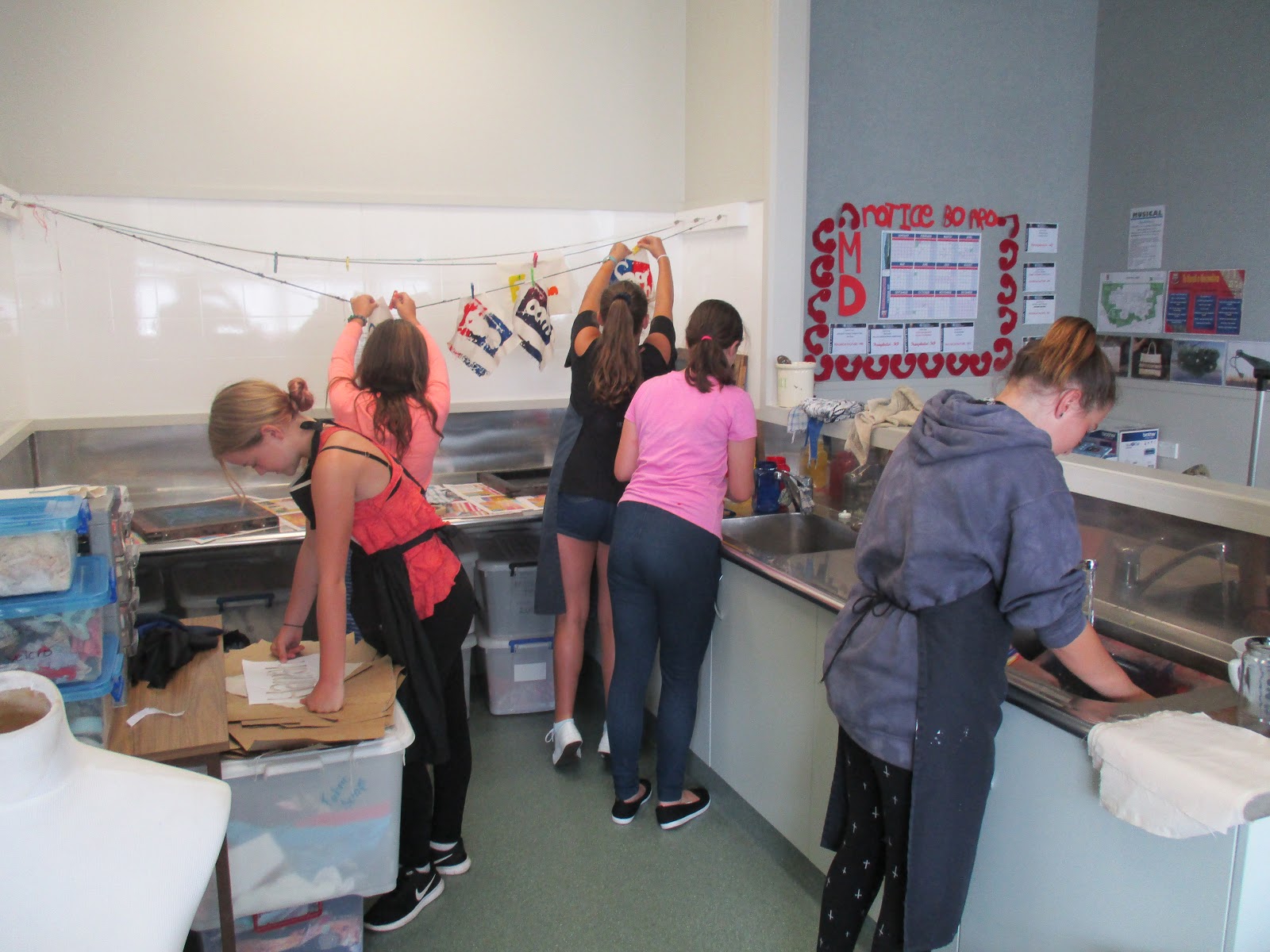
The year 9's have been learning about the screen printing process and thinking about all the possible stencil designs they could create to go on their drawstring bag. During this process, I observed the positive relationships that have been developing and the support the students provide one another. Proud teacher moment!!!


Here's an image of some of the students in action and their final products...

Thursday, 30 March 2017
Textile's Easter Raffle
31/3 Update: This basket now contains over $200 worth of beauty products and chocolate!!!!
Tuesday, 28 March 2017
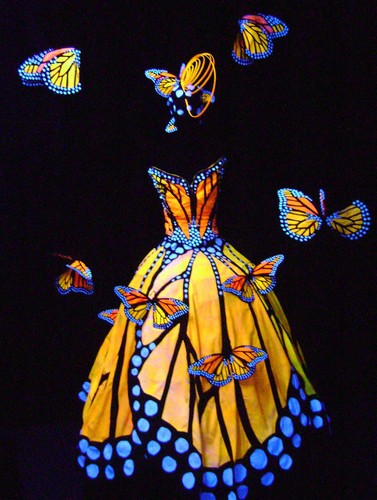
Tokoroa High School Wearable Arts Show 2017


·
Please complete the entry form
online. You can find the entry form on the link above.
· Entry and fee of $10.00 per wearable art
must be received no later than 24 July 2017. No late entries will be
accepted.
·
Fees can be paid electronically at BNZ
020464002635600 with the student entry name as reference or at the school
office.
Here's an example of what to expect on the entry form:
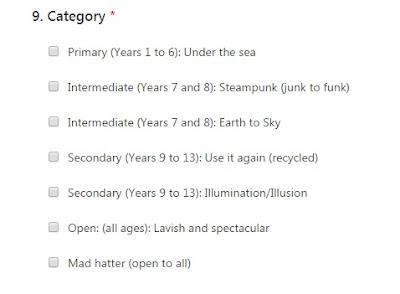

Here's an example of what to expect on the entry form:


Tokoroa High School Wearable Arts Show 2017
Please read the conditions of entry
carefully before creating your garment.
·
New rule - Each contestant can only
wear one garment. If a contestant
chooses to enter in more than one category, then each garment must be worn by a
different model.
·
Garments must be safe to wear. No
sharp edges or items that could cause bodily harm to models, designers, or back
stage staff are permitted. This is an obvious safety precaution.
Creations must be able to be clothes at least three times and need to be
constructed so they can be taken on and off without too much difficulty.
·
You should supply your own models for all
entries.
·
The garments must be completed and
available by the date of rehearsal which will be held on 4 August 2017 at the
Tokoroa Sports and Events centre.
·
Rehearsals will begin at 10am so
contestants will need to be at the centre by 9am to be fully dressed for
rehearsal and meeting with the judges.
·
Contestants in the first half of the
programme will have their photos done and meet the judges first while the
contestants in the second half of the programme will be at rehearsal on the
stage. After lunch, the order will be reversed.
·
Only the student entrants and their
models will be allowed with the judges. No parents/caregivers will be
permitted with judging.
·
A pack with final details about the
programme will be available to all contestants once the registrations have
closed and the programme decided on.
·
You cannot enter the same wearable art
into more than one category. Each entry has a non-refundable entry fee.
·
Creations Size – Measurements no more
than 2m wide or 3m high.
·
This is a community event attracting a
large audience. Standards acceptable in the general community will be
upheld. The organiser reserves the right to refuse any entrant to take
part in any or all aspects of the event if the organiser determines, at their
discretion, that the entrant, model or garment is not suitable.
·
Prizes are not transferable. The
organisers reserve the right, at their discretion, to use the winners’ name,
address, and photographs of the garments, models and/or designers for
promotional purposes.
·
Judges’ decision is final and no
correspondence will be entered into. In a dispute over which category and
entry will be judged in, the organising committee’s decision is final.
·
Student entrants will remain the
responsibility of their parent/caregiver at all times during the event and in
the lead-up to the event.
·
Completed creations (including accessory
parts) must be able to be carried, pushed, and supported by the model
alone. No parents/caregivers or helpers are permitted back stage.
·
The winner for Mad Hatter is a
stand-alone prize winner, which means the winner of this section will not be
among the finalists for the supreme award.
·
The Mad Hatter and Lavish and
Spectacular sections are open to all age groups.
·
The supreme award winner will be selected
from the overall winners.
·
Disclosure is necessary if the creation
has entered another competition.
·
All Rules and Conditions are subject to
change at the discretion of Tokoroa High School, but will be communicated well
before the event should such an amendment occur.
Tokoroa
High School Wearable Arts show 2017
Subscribe to:
Posts (Atom)